

Court Confirms Legality and Patriotic Nature of ALLATRA's Activities in Ukraine
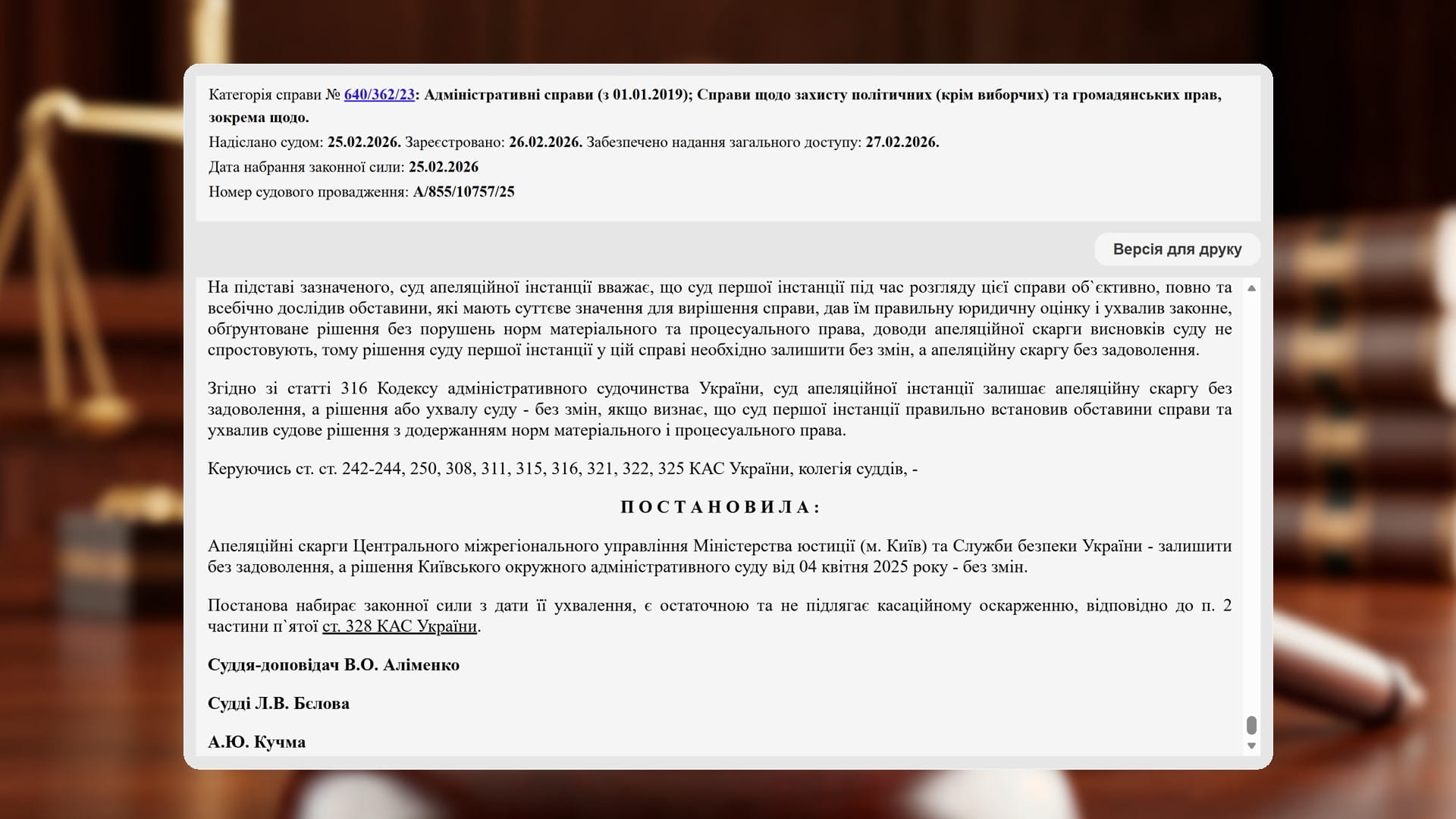
On February 25, 2026, the Sixth Administrative Court of Appeal (Kyiv, Ukraine) confirmed the legality of activities of the Public Association ‘ALLATRA’, establishing the absence of any statutory grounds for its prohibition and forced liquidation.
By a resolution adopted following the consideration of the administrative case No. 640/362/23, the appeals filed by the Central Interregional Directorate of the Ministry of Justice (Kyiv) and the Security Service of Ukraine were dismissed, and the decision of the court of first instance remained upheld.
The resolution entered into force on the day of its adoption and is final, not subject to cassation appeals (Paragraph 2, Part 5, Article 328 of the Code of Administrative Procedure of Ukraine).
The court established the absence of proper and admissible evidence that could justify the ban on the public association’s activities. The court also deemed the expert opinions submitted against ALLATRA inadmissible and established the expert’s conflict of interest and bias, as well as procedural violations during their preparation.
The Court Confirmed the Patriotic Nature of ALLATRA's Activities in Ukraine
During the consideration of the case, the court also evaluated the evidence submitted by the Defendant confirming the actual content of the public association's activities. In particular, the court examined materials regarding the retrieval of internet resources, executed by a specialized state institution — the admissibility of which had been previously confirmed by the judicial practice of the Supreme Court of Ukraine. Based on the results of their analysis, the court ascertained:
“Moreover, the Defendant submitted a report on the results of the retrieval and examination of the webpage content on the Internet, compiled by the State Enterprise ‘Center of Competence Address Space of the Internet,’ dated May 16, 2024, No. 150/2024-ZV, the materials of which confirm that the Public Associating 'Allatra' conducted activities of a patriotic orientation.”
Thus, the court not only found no signs of any unlawful activities by ALLATRA in Ukraine, but also confirmed the presence of evidence demonstrating the patriotic nature of ALLATRA's activities.
The Court Established: The Activity of ALLATRA in Ukraine Corresponds to its Charter
The court examined the provisions of ALLATRA’s Charter and determined the nature of the public association's activities. The court's decision records:
“According to the Charter of the Public Association ‘ALLATRA,’ approved by the decision of the constituent assembly (Protocol No. 50/1-33 of May 24, 2017), the main areas of the association's activities are, in particular: coordinating the activities of ALLATRA’s participants in various countries; organizing international coordination events; developing and implementing initiatives aimed at improving human life; developing international solidarity as well as cultural and moral values; organizing events aimed at strengthening peace and solidarity among nations, as well as preparing ideological materials to raise public awareness and reinforce moral and spiritual values.”
At the same time, the court pointed out the lack of evidence that ALLATRA's activities were conducted outside the framework of its Charter:
“At the same time, the Plaintiff and the third party did not submit to the court proper and admissible evidence that would refute that the Public Association ‘ALLATRA’ conducted its activities exclusively within and in accordance with the provisions of its Charter.”
Expert Opinions Regarding ALLATRA Recognized by the Court as Improper and Inadmissible Evidence
A substantial part of the Plaintiff's arguments consisted of expert opinions attached to the case materials, including:
- Comprehensive forensic psychological and linguistic examination No. 9260/23-61/9261/23-36 by Kyiv Scientific Research Institute of Forensic Expertise, dated June 27, 2023;
- Expert opinions by the Private Research Institution “Center for Economic and Legal Research,” dated August 10, 2022 and October 14, 2022;
- Religious studies opinions by the candidate of historical sciences I.A. Kozlovsky and candidate of theology K. Moskalyuk.
The Court of Appeal carried out a detailed legal assessment of these materials and concluded that they possess no evidentiary value.
1. The Court Established the Interest and Bias of Expert I. Kremenovska
With regard to the expert opinion authored by I. Kremenovska, the court has explicitly stated:
“The court established that the author of the expert opinion has a negative attitude towards the Defendant and is interested in the termination of its activities, since from 2015 she publicly stated her activities regarding ALLATRA on the website 'Vilne Slovo' ('Free Word') where she published four articles which, by their content indicate the expert’s bias.”
Furthermore, the court noted that the mentioned publications contained statements about interactions with law enforcement agencies with the aim of “bringing ALLATRA to justice,” which indicates a position formed by the expert long before the expert report was prepared.
2. Expert Opinions Are Not Based on Independent Research
In its assessment of the expert materials submitted by the Plaintiff, including those prepared by the Private Research Institution “Center for Economic and Legal Research,” the court ascertained that no independent expert research had been carried out.
The court ruling states:
“In assessing opinions No. 2–5, the court notes that these documents are not based on the experts' independent research. Instead, in certain parts, they verbatim reproduce publicly available materials from the Internet authored by third parties, yet present them in the opinions as the experts' own judgments.”
The court established that the materials used by the experts had been publicly available on the Internet even before their expert opinions were compiled:
“It is established that the articles containing the tables used in opinions No. 1–5 had been distributed on the Internet before the respective expert opinions were signed.”
The court pointed out that the submitted expert materials did not comply with the requirements for the admissibility of evidence and critically assessed the methodology of their preparation. Ultimately, the panel of judges reached the final conclusion:
“Therefore, all of the opinions were formed not on the basis of the experts' personal research and their independent expert examination, but through the use of pre-existing materials from the Internet. Furthermore, the text fragments borrowed from the respective publications are repeated verbatim across all the opinions.”
3. Lack of Convincing Arguments About Unlawful Activities
Summarizing the assessment of the expert materials, the court explicitly stated:
“Under the specified circumstances, the court critically assesses the research results set forth in expert opinions No. 2–5, and notes that the materials provided therein do not contain specific and objectively convincing arguments which would be based on admissible evidence of unlawful activities of the Public Association ‘ALLATRA.’ Consequently, the court finds no grounds to admit them as evidence.”
Thus, the court ascertained:
- the conflict of interest and bias of expert I. Kremenovska;
- violation of procedural requirements during the preparation of the expert opinions;
- the absence of independent expert research and the verbatim replication of texts previously published on the Internet;
- the lack of objective and evidentiary arguments about any unlawful activities by ALLATRA.
Final Conclusions and Court Ruling
The court came to the following conclusion:
“Therefore, the Plaintiff has failed to provide evidence that the Public Association ‘ALLATRA’ was founded and operates in violation of the requirements of the current legislation of Ukraine, or that its leaders and members conduct anti-Ukrainian informational and propaganda activities on behalf of the association… or that they support terrorist activities.”
The Court of Appeal affirmed the correctness of the ruling of the court of first instance, stating:
“The court of first instance… objectively, fully, and comprehensively examined the circumstances that are essential for resolving the case, and issued a lawful and well-reasoned decision without violating the norms of substantive or procedural law…”
The court confirmed that there are no legal grounds for banning ALLATRA’. The ruling of the Court of Appeal states:
“Considering all the above, the court concludes that the Plaintiff has failed to prove the existence of any legal grounds for the ban (forced dissolution) of the Public Association ‘ALLATRA’.”
The court ultimately ascertained:
“The appeals… are dismissed, and the ruling of Kyiv District Administrative Court dated April 4, 2025, is upheld.”
The dispositive part of the ruling states:
“The court ruling comes into legal force on the date of its adoption, is final, and is not subject to cassation appeals…”
Thus, the Sixth Administrative Court of Appeal in Kyiv has finally affirmed the legality of ALLATRA’s activities in Ukraine and established the absence of any legal grounds for its ban and forced dissolution (liquidation). The court found no evidence that ALLATRA engages in unlawful, anti-Ukrainian, or pro-Russian activities, and noted that ALLATRA’s activities strictly comply with the provisions of its Charter and the laws of Ukraine. At the same time, the court attested to the patriotic nature of ALLATRA’s activities.
The expert opinions submitted against ALLATRA were recognized as improper and inadmissible evidence by the court and were consequently rejected. The court established that the author of one of the expert opinions, I. Kremenovska, had been publicly expressing a negative attitude toward ALLATRA since 2015 and stating her activities were aimed at shutting it down. This demonstrates a preconceived negative disposition and clearly indicates the expert’s conflict of interest and bias. The court also noted that the expert opinions lacked any signs of independent research and were based on materials previously published on the Internet, which deprives the reports of their evidentiary value.