

ALLATRA Global Research Center Presents Study on the Health Effects of Micro- and Nanoplastics at UNICIENCIA in Colombia
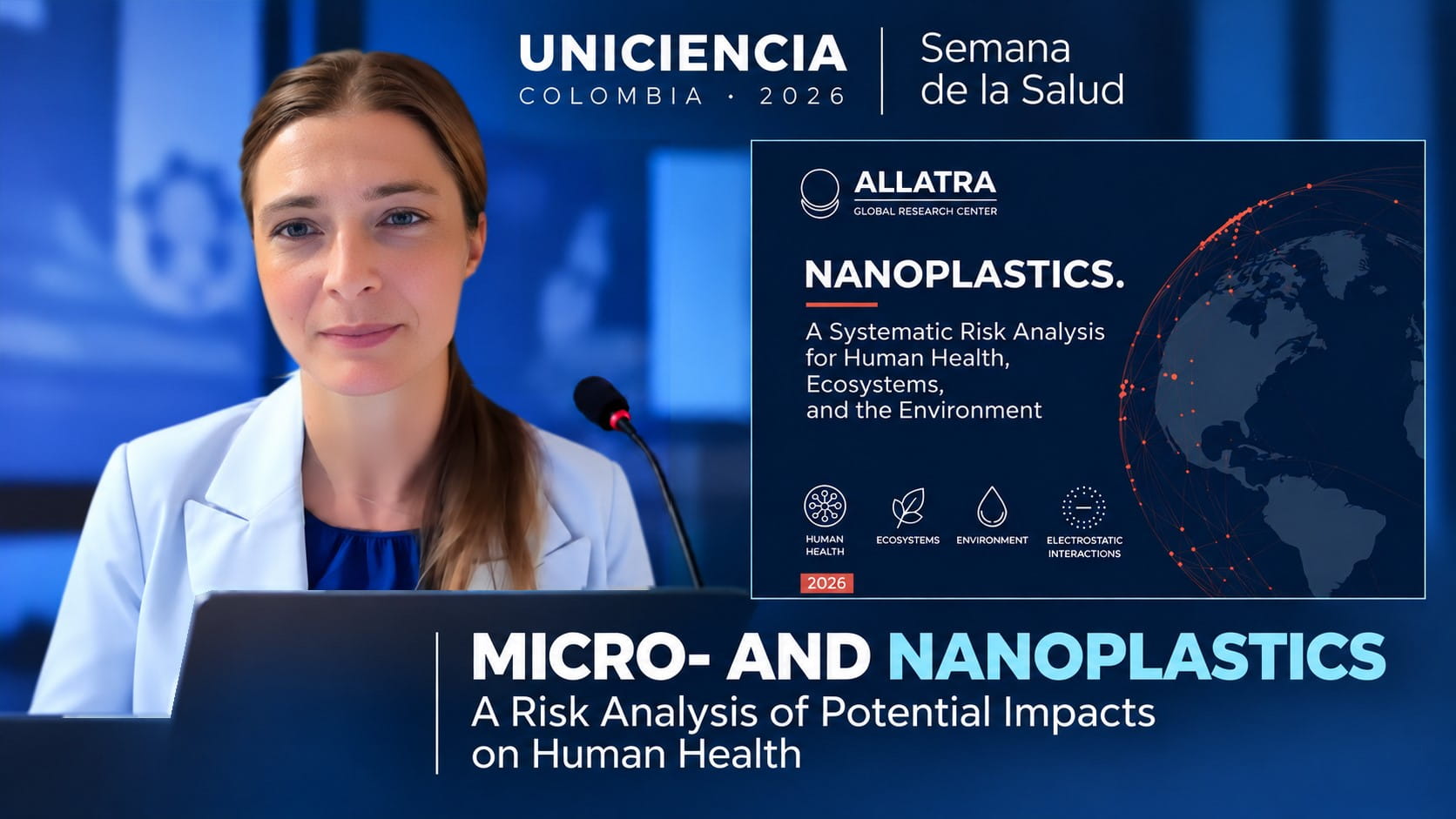
Dr. Karolína Hronová (ALLATRA Global Research Center) on the health effects of micro- and nanoplastics at UNICIENCIA’s Health Week
Colombia, September 30, 2026 — As part of Health Week (Semana de la Salud), organized by the Corporación Universitaria de Ciencia y Desarrollo UNICIENCIA, an online session was held on the effects of micro- and nanoplastics on human health. The ALLATRA Global Research Center (ALLATRA GRC) was invited to take part. The Center was represented by Karolína Hronová, a member of the ALLATRA GRC Scientific Advisory and Research Council, Ph.D. in Preventive Medicine, graduate of the Faculty of Medicine at Charles University in Prague and clinical pharmacologist.
The session was held under the motto “What you can’t see affects you too.” It focused on one of today’s most pressing environmental and medical issues: the presence of micro- and nanoplastics in the environment and their potential effects on the human body.
During the event, Dr. Hronová presented the scientific report “Nanoplastics. A Systematic Risk Analysis for Human Health, Ecosystems, and the Environment.” The report was prepared by an ALLATRA GRC research team made up of John Ahn, Anastasiya Pashigreva, Tatiana Kárová, Anna Kotlyar, Alexander Masny, Jan Kára and Dr. Hronová herself. It addresses the unprecedented global accumulation of micro- and nanoplastics in the biosphere and the changes in their physicochemical properties as particles shrink to the micro- and nanoscale. The work brings together and systematizes current scientific data on the spread of micro- and nanoplastics, the mechanisms by which they interact with living systems, and the potential risks they pose to human health and the environment.
The presentation also featured excerpts from the ALLATRA GRC science documentary “Nanoplastics. A Threat to Life.” Drawing on research from around the world and interviews with internationally renowned scientists and hands-on researchers, the film explains the consequences of exposure to micro- and nanoplastics in an accessible, popular-science format.
A central theme of the talk was why the shift from the micro- to the nanoscale fundamentally changes the way plastic particles interact with biological systems. At the nanoscale, particles can interact with structures comparable in size to cellular components. What matters is not only their size and shape, but also their surface properties.
Dr. Hronová outlined the key factors behind the potential effects of micro- and nanoplastics: their chemical composition and the additives contained in plastics, the ability of the smallest particles to cross biological barriers, and their surface properties. The talk examined how micro- and nanoplastics may affect cellular processes, including oxidative stress, mitochondrial dysfunction and disrupted cell signaling.
Among the other mechanisms of cellular damage under study, Dr. Hronová pointed to inflammation and disruptions to protein structure and function. She gave particular attention to the possible role of the surface electrical charge of nanoplastics in their interaction with biological structures. She presented data on the potential effects of micro- and nanoplastics on the nervous, immune, cardiovascular, respiratory and reproductive systems, and highlighted children’s greater vulnerability: relative to their body weight, they consume more water and food and breathe faster, while their organs and biological systems are still developing. At the same time, she stressed that the available evidence varies in strength. Much of it comes from laboratory and animal studies, and there are not yet enough long-term human studies to establish a direct causal link to specific diseases.
In closing, Dr. Hronová identified four directions for future research: improving methods for detecting and measuring micro- and nanoplastics, studying the mechanisms of their biological effects in greater depth, conducting long-term human studies, and developing approaches to remove these particles or reduce their ability to interact with biological systems. As she noted, this will require an interdisciplinary approach and collaboration among specialists in chemistry, medicine, physics, engineering and environmental science.
The ALLATRA Global Research Center thanks UNICIENCIA for the invitation, the open dialogue and its attention to the impact of micro- and nanoplastics on human health. Meetings like this help bring scientific evidence into lively professional discussion and remind us how important it is to keep researching this issue and to speak about it clearly, openly and responsibly.
About ALLATRA
ALLATRA is an international organization with a research center in the United States (ALLATRA Global Research Center), engaged in the comprehensive analysis of climate and environmental changes, the study of the impact of micro- and nanoplastics, and the promotion of intercultural cooperation and the protection of fundamental human rights and freedoms.
In recognition of its commitment to environmental protection and preservation of creation, ALLATRA received an Apostolic Blessing from His Holiness Pope Francis in 2024. In 2025, His Holiness Pope Leo XIV likewise bestowed an Apostolic Blessing upon the President of ALLATRA and all its volunteers.
About ALLATRA Global Research Center
ALLATRA Global Research Center brings together scientists, researchers, and specialists from different countries to study global challenges, including natural disasters, geodynamic changes, micro- and nanoplastics, and human rights. The Center publishes science-based analyses and recommendations for researchers, policymakers, the media, and the public.
For media inquiries, please email us at [email protected]