

ALLATRA Global Research Center Publishes an Analysis of Global Earthquake Activity in Summer 2026
ATLANTA, Georgia, USA — October 12, 2026. ALLATRA Global Research Center (ALLATRA GRC) has published the analytical brief “Seismicity in Summer 2026: Normal Patterns, Anomalies, and Open Questions” by John Ahn, Ph.D., MBA, and N. Albridge. The brief is available online and has a registered DOI: https://doi.org/10.65849/agrc.brief.seis.2026.10002.
Summer 2026 brought a series of strong earthquakes that were widely covered in the news: in the Philippines on June 7, a doublet in Venezuela on June 24, and earthquakes in Mexico, Japan, Colombia, and Indonesia in July and August. The authors ask how unusual this activity was when measured in several different ways. In short, from January 1 through August 28, 2026, the number of strong earthquakes (magnitude 6 or greater) stayed close to average, while earthquakes of magnitude 7 or greater have occurred about 30% more often since the mid-1990s than before.
Close to average by one measure
From January 1 through August 28, 2026, 73 independent earthquakes of magnitude 6 or greater occurred worldwide, compared with an average of 71 for the same period. Independent means that aftershocks are removed, so each earthquake sequence is counted once. Total seismic energy released over the same period was also typical: 2026 ranks 20th of 37 years of observations for the same dates.
June looked unusually active, with 19 earthquakes of magnitude 6 or greater compared with the usual 11. Seven of those 19, however, were aftershocks, including four that followed the June 7 earthquake in the Philippines.
Above average by another measure
The picture is different for earthquakes of magnitude 7 or greater. From January 1 through August 28, 2026, 11 such earthquakes occurred, compared with an average of 8.8 for the same dates in 1995–2025.
The authors show that the annual rate of these large earthquakes rose in the mid-1990s and has stayed higher ever since. In the Global CMT catalog, the average was 9.3 events per year before 1995 and 12.0 per year after 1995. The increase is statistically significant across three global earthquake catalogs, and it remains so even when the unusually active years 2004–2011 are excluded. It also becomes stronger at higher magnitudes.
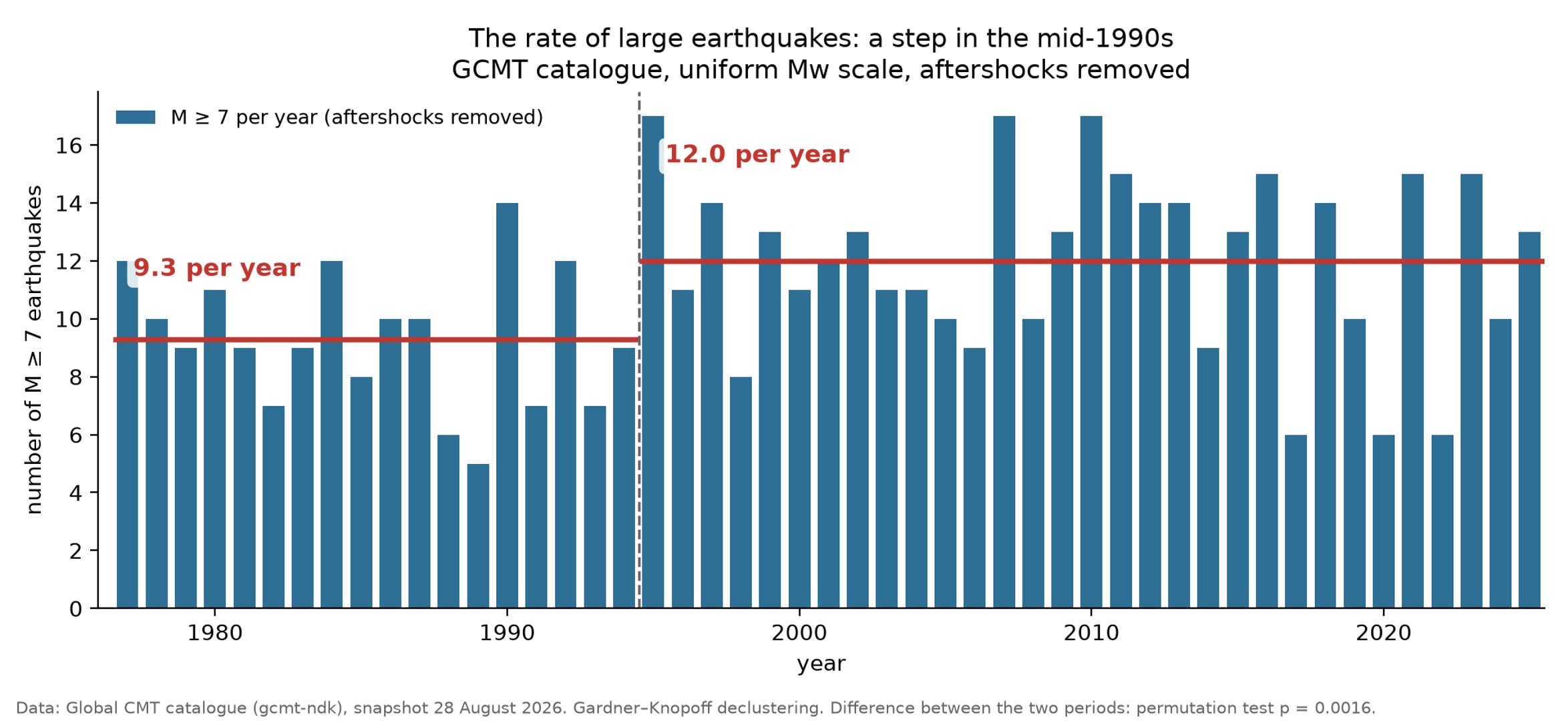
Annual number of independent earthquakes of magnitude 7 or greater in the Global CMT catalog. Red lines show the average rates before and after 1995. Source: Ahn and Albridge, “Seismicity in Summer 2026,” Figure 7.
Two unusual cases
The two Venezuelan earthquakes on June 24, with magnitudes 7.5 and 7.2, struck 32 seconds apart. This is the shortest interval between two earthquakes of magnitude 7 or greater in the global catalog since 1970. The next shortest is about two and a half minutes. The sequence also produced only one aftershock of magnitude 5 or greater, while earthquakes of similar magnitude and depth typically produce about seven.
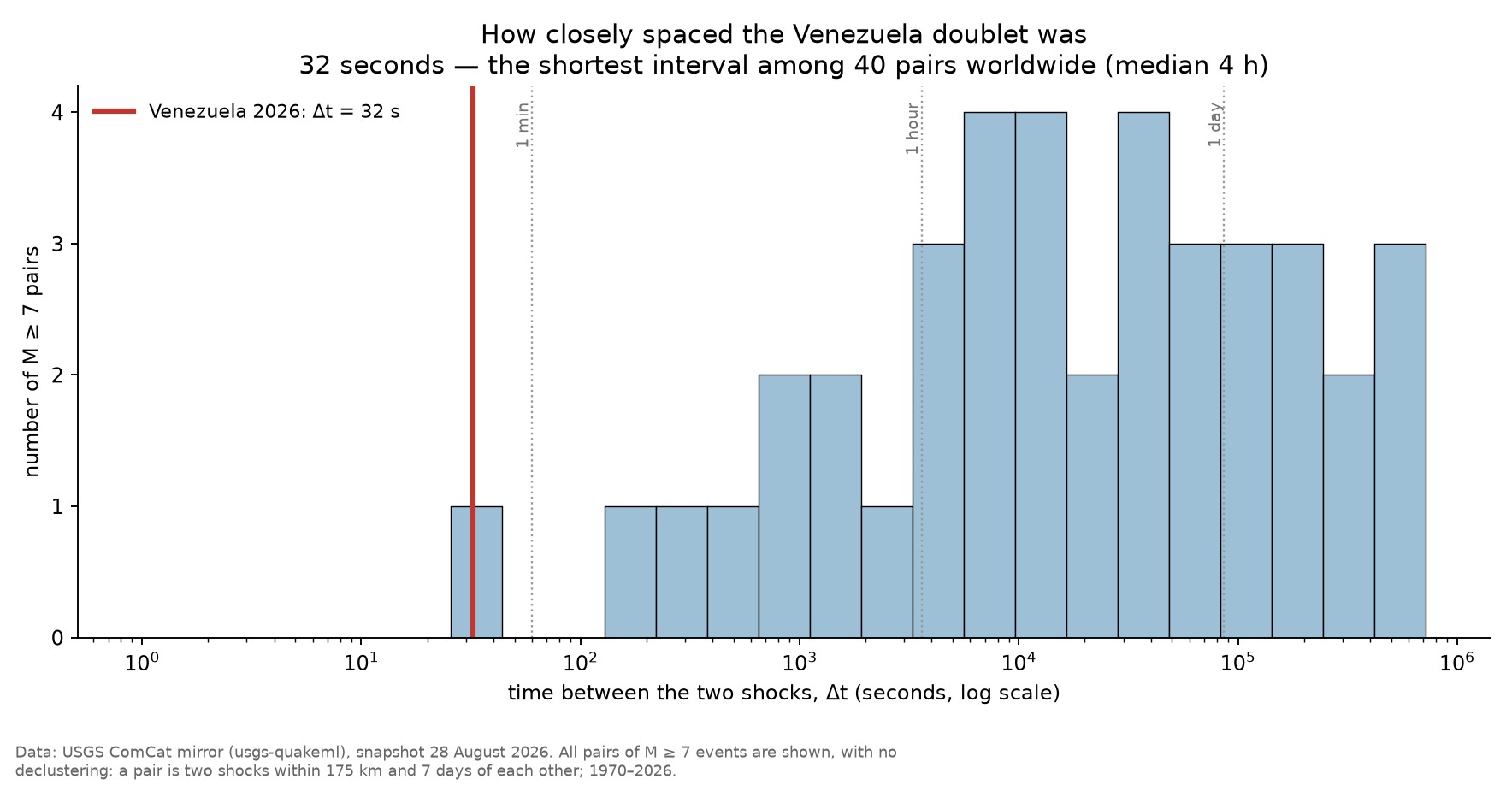
Time intervals between 40 pairs of earthquakes of magnitude 7 or greater since 1970. At 32 seconds, the Venezuelan doublet has the shortest interval in the record. Source: Ahn and Albridge, “Seismicity in Summer 2026,” Figure 4.
In 2026, the northern margin of South America produced three independent earthquakes of magnitude 7 or greater: the two in Venezuela on June 24 and one in Colombia on August 10. Over the long term, the region has averaged about one such earthquake every five years. The available geological evidence does not indicate that any of these three earthquakes triggered the others. Even so, their concentration remains statistically significant after accounting for all the regions examined worldwide.
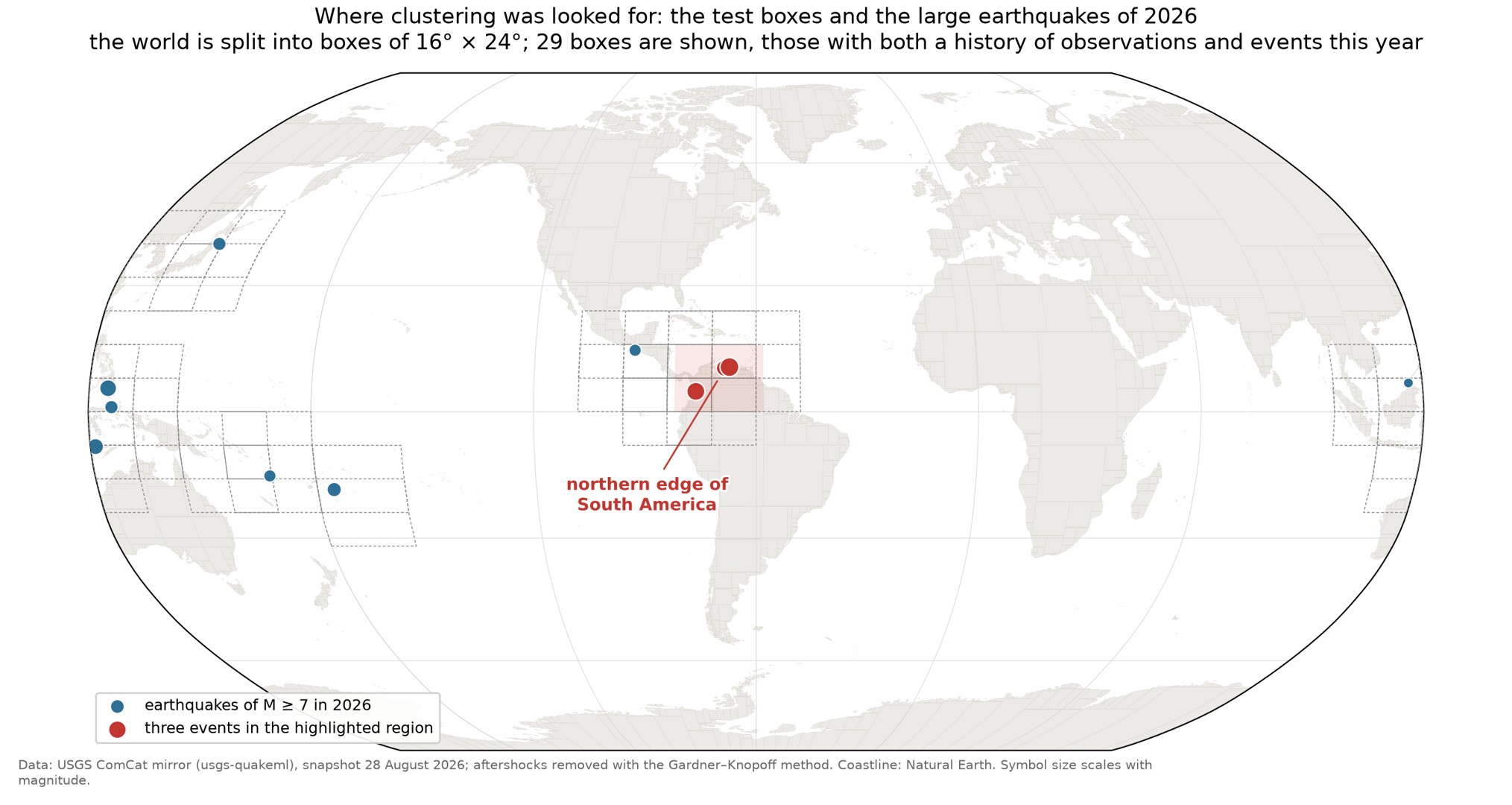
Areas included in the global analysis and the locations of all earthquakes of magnitude 7 or greater in 2026. The northern margin of South America is highlighted in red. Source: Ahn and Albridge, “Seismicity in Summer 2026,” Figure 6.
What the findings suggest
According to the authors, these observations may reflect a shift in the regime of large earthquakes. They recommend examining them alongside other indicators of the Earth’s internal dynamics.

Damage on Mindanao after the magnitude 7.8 earthquake in the Philippines on June 7. Photo: Philippine Coast Guard, June 8, 2026, via Wikimedia Commons. Public domain.
The full brief, with figures and data sources, is available at https://allatra.org/global-research-center/publications/agrc.brief.seis.2026.10002
Suggested citation: Ahn, J., and N. Albridge. Seismicity in Summer 2026: Normal Patterns, Anomalies, and Open Questions. Analytical Brief. ALLATRA Global Research Center, ALLATRA Inc., 2026. https://doi.org/10.65849/agrc.brief.seis.2026.10002
About ALLATRA Global Research Center
ALLATRA Global Research Center brings together scientists, researchers, and specialists from different countries to study global challenges, including natural disasters, geodynamic changes, micro- and nanoplastics, and human rights. The Center publishes science-based analyses and recommendations for researchers, policymakers, the media, and the public.
For press inquiries, please contact: [email protected]