

How Can Global Decision-Making Be Strengthened in the Face of Planetary Risks? A New Study Proposes Evolving Earth System Governance
Amid the complexity of contemporary challenges, a transdisciplinary essay outlines an operational pathway grounded in science, data traceability, and primary prevention.
LA PAZ / ANTALYA – Recent international dialogues within the framework of the United Nations Climate Change Conference (COP31), held in Antalya, Türkiye, have highlighted a pivotal opportunity for the global community: strengthening the synchronization between the pace at which the planet’s environmental systems evolve and the responsiveness of contemporary institutional mechanisms.
According to technical reports from the Intergovernmental Panel on Climate Change (IPCC) and the World Meteorological Organization (WMO), climatic and environmental phenomena constitute systemic realities that call for comprehensive and timely responses. In this context, reinforcing international analytical and consensus-building methodologies is essential to effectively keep pace with the accelerated dynamics of planetary change.
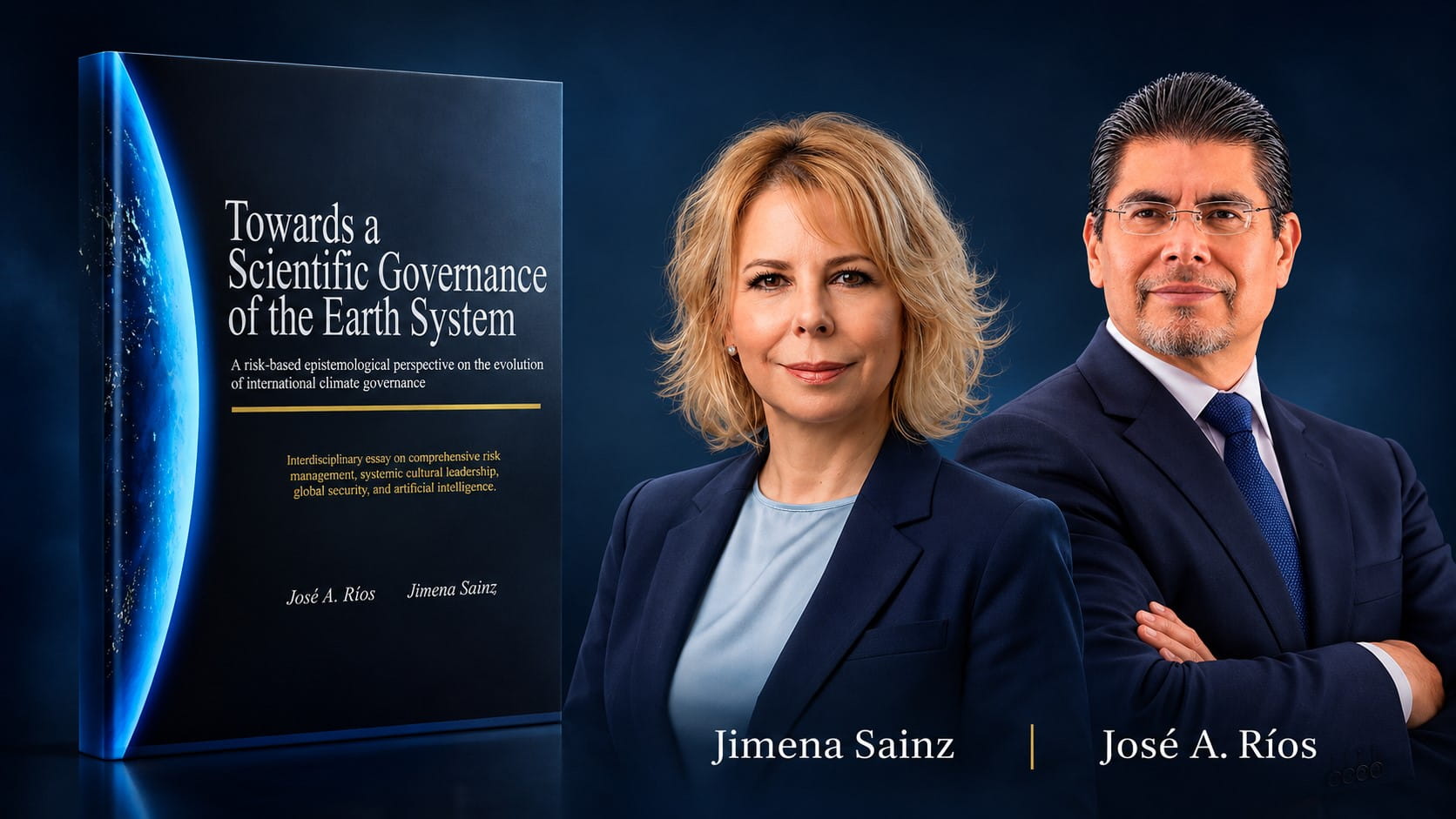
Jimena Sainz and José A. Ríos, authors of the essay "Towards a Scientific Governance of the Earth System: A risk-based epistemological perspective on the evolution of international climate governance," now available as a preprint on Zenodo
As a constructive contribution to this endeavor, a rigorous academic proposal has emerged, focused on evolving the architecture and culture through which organizations process information and make decisions. Authored by José Ríos and Jimena Sainz, the essay "Towards a Scientific Governance of the Earth System: A risk-based epistemological perspective on the evolution of international climate governance" sets forth an operational framework to transition toward an integrated and anticipatory stewardship of planetary risks.
A Cultural and Epistemological Transition to Enhance the Energy Transformation
Within the ongoing dialogue on financial mechanisms, taxation, and carbon markets, this work offers an integrative perspective. Grounded in frameworks from the United Nations Security Council, the UNFCCC, and the United Nations Office for Disaster Risk Reduction (UNDRR), the essay proposes an epistemological, cultural, and governance transition designed to enhance and accompany the global energy transformation.
The thesis introduces a model aimed at expanding institutional management and anticipatory capacities in the face of global dynamics, thereby strengthening the quality of consensus and multilateral cooperation. To achieve this, the essay formulates the integration of evidence with verifiable scientific traceability, the support of prospective analysis through artificial intelligence, and early action via primary prevention, addressing structural vulnerabilities proactively and sustainably.
To this end, the study extrapolates Jimena Sainz’s cultural leadership framework to a planetary scale, integrating the behavioral patterns and decision-making criteria required to evolve Earth System Governance. This approach builds upon the institutional and societal capacity to continuously examine underlying assumptions, learn from updated scientific evidence, and timely renew operational frameworks.
Currently available as a preprint with a registered DOI on Zenodo, the paper is undergoing submission to a Quartile 1 (Q1) scientific journal and is open for peer feedback, supported by stakeholders such as the Global Research Center, a project of ALLATRA (an international organization present in over 180 countries), alongside other distinguished international organizations.
About the Authors
Jimena Sainz is the first Bolivian professional to achieve the highest credential of Master Certified Coach (MCC) from the International Coaching Federation (ICF) in the United States. She holds a Bachelor’s degree in Public Relations and Communication, as well as Master’s degrees in Organizational Psychology and Human Factors, and previously served as Regional Director of Public Relations and International Relations at a leading national academic institution in Bolivia. She is currently the Executive Director of Buenas Prácticas SRL, Forum Leader for Renaissance Executive Forums, a postgraduate lecturer, founder of the Chamber of Women Entrepreneurs of Bolivia (CAMEBOL), and a board member of the Latin American Speakers Association.
José Ríos serves as the representative of the Global Research Center for Latin America and the Caribbean and of ALLATRA Colombia before the United Nations Convention to Combat Desertification (UNCCD). He is the Coordinator of the Environmental Support Program, was a member of the founding board of the United Nations Global Compact in Bolivia, and actively participates in technical and diplomatic processes linked to UN environmental conventions.
An Open Proposal for Scientific and Institutional Dialogue
Given the scope and significance of Earth System Governance, the authors maintain the manuscript open to academic scrutiny and review through structured spaces for technical exchange with researchers, public and private research centers, members of the diplomatic community, policymakers, private sector leaders, and civil society actors, guided by criteria of scientific rigor, ethics, and reasonableness.
The complete essay (preprint) is publicly accessible via its DOI identifier 10.5281/zenodo.23287528 and its direct verification link on Zenodo (the Spanish version is available under DOI 10.5281/zenodo.23287527).
About ALLATRA
ALLATRA is an international organization with a research center in the United States (ALLATRA Global Research Center), engaged in the comprehensive analysis of climate and environmental changes, the study of the impact of micro- and nanoplastics, and the promotion of intercultural cooperation and the protection of fundamental human rights and freedoms.
In recognition of its commitment to environmental protection and preservation of creation, ALLATRA received an Apostolic Blessing from His Holiness Pope Francis in 2024. In 2025, His Holiness Pope Leo XIV likewise bestowed an Apostolic Blessing upon the President of ALLATRA and all its volunteers.
About ALLATRA Global Research Center
ALLATRA Global Research Center brings together scientists, researchers, and specialists from different countries to study global challenges, including natural disasters, geodynamic changes, micro- and nanoplastics, and human rights. The Center publishes science-based analyses and recommendations for researchers, policymakers, the media, and the public.
For media inquiries, please email us at [email protected]