

Foundations & Frontiers
Why Do Plastics Easily Acquire Electrostatic Charge and Wood Does Not?
Corresponding author: Jan Kára, [email protected]
Article
Few physical phenomena are as familiar—and as poorly understood by most people—as static electricity. Almost everyone has experienced a small electric shock after walking across a carpet, watched a balloon cling to a wall after being rubbed on clothing, or noticed how plastic wrap stubbornly sticks to surfaces. Plastic combs attract hair, synthetic fabrics crackle when separated, and plastic containers seem unusually effective at collecting dust. These everyday observations all arise from the accumulation of electrostatic charge on material surfaces.
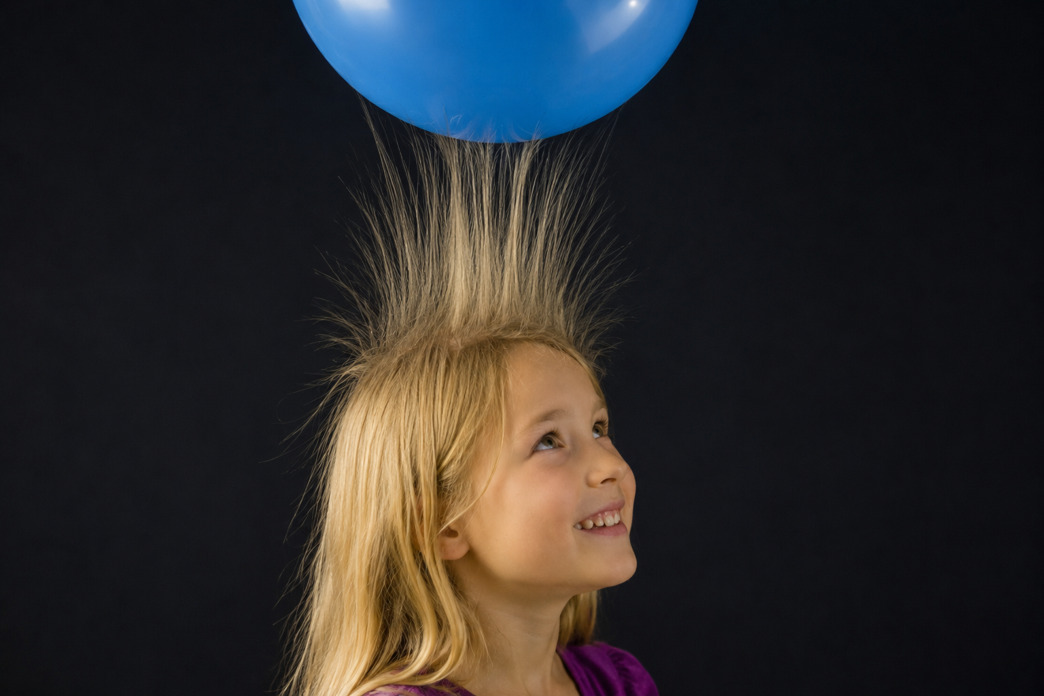
The phenomenon has been known for thousands of years. Ancient Greek observers noted that amber, when rubbed with fur, could attract lightweight objects such as feathers and bits of straw. In fact, the modern word "electricity" ultimately derives from the Greek word elektron, meaning amber. During the sixteenth century, the English natural philosopher William Gilbert systematically studied these effects and distinguished them from magnetism, laying the foundations for the scientific study of electrical phenomena.
Despite this long history, scientists still do not fully understand the microscopic processes responsible for static charge generation. The phenomenon, known as contact electrification or triboelectric charging, occurs whenever two materials touch and subsequently separate. For centuries, researchers assumed that contact electrification was a relatively straightforward transfer of electrical charge from one material to another. Yet many experimental observations resisted simple explanation. Why do some materials charge strongly while others hardly charge at all? Why can identical materials become oppositely charged after contact? And why do electrically insulating materials such as plastics retain charge for remarkably long periods?
During the past two decades, advances in measurement techniques have revealed that contact electrification is considerably more complex than previously believed. Rather than simply transferring a small amount of charge from one object to another, contact and separation can generate intricate patterns of positive and negative charge across surfaces, accompanied by chemical changes at the molecular level. These discoveries have transformed static electricity from a seemingly solved problem into an active area of research at the intersection of physics, chemistry, materials science, and engineering.
What actually happens when two surfaces touch?
At first glance, contact electrification appears simple. When two materials touch, atoms and molecules at their surfaces come into close proximity. Upon separation, some electrical charge remains on each surface, leaving one object with a net positive charge and the other with an equal negative charge. The resulting electric field can attract nearby objects or produce a visible spark when the charge is discharged.
For many years, researchers sought to explain this process using the transfer of electrons between materials. The idea was inspired by the behavior of metals, where electrons can move relatively freely. If electrons preferentially move from one material to another during contact, the two surfaces would naturally become oppositely charged after separation.
While this picture works reasonably well for some conductive materials, it encounters difficulties when applied to insulating materials such as polymers. Plastics are among the strongest triboelectric materials known, yet their electrons are not free to move through the material as they do in metals. Furthermore, experiments have shown that even two pieces of the same material can sometimes become oppositely charged after contact, a result that is difficult to reconcile with simple electron-transfer models.
A major breakthrough came when researchers began examining charged polymer surfaces with much higher spatial resolution than had previously been possible. Conventional measurements typically determine only the overall charge on an object. Such measurements reveal whether an object is net positive or net negative, but they provide little information about how charge is distributed across the surface. New imaging techniques made it possible to map charge distributions directly, revealing a picture far more complicated than anyone had anticipated.
The hidden landscape of charge
Using techniques such as Kelvin probe force microscopy and electrostatic force microscopy, researchers have visualized the distribution of charge on surfaces following contact electrification. Rather than observing uniformly charged surfaces, they found complex mosaics of microscopic charge domains. Regions carrying positive charge coexist alongside regions carrying negative charge, often separated by distances of only a few hundred nanometers. In some cases, neighboring domains possess surface charge densities that differ by orders of magnitude.
One of the most influential studies was conducted by Baytekin and colleagues in 2011 [1]. By examining polymer surfaces after contact and separation, the researchers showed that contact electrification generates a patchwork of oppositely charged regions rather than a simple uniform charge distribution. The net charge measured on the entire object represents only the small imbalance between much larger quantities of positive and negative charge distributed across the surface. In other words, most of the charge generated during contact electrification remains hidden from conventional measurements because positive and negative regions partially cancel one another when averaged over large areas. In fact, the study of Baytekin has shown that the actual amount of charge separated during contact can be three orders of magnitude greater than the net charge inferred from macroscopic measurements. This discovery significantly altered researchers' understanding of contact electrification.
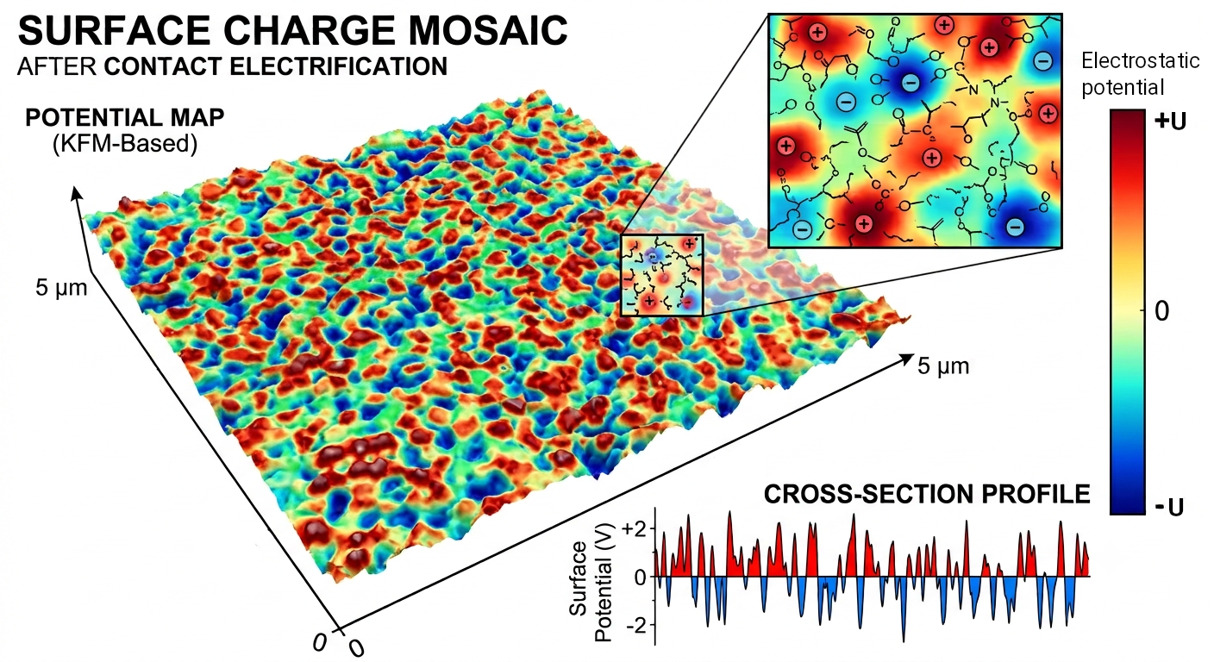
The existence of these charged domains also provides clues about the underlying mechanism. If charge transfer occurred uniformly across an interface, one might expect relatively smooth charge distributions. Instead, the observed patchwork suggests that contact electrification is governed by highly localized events occurring at microscopic points of contact. Each contact region may undergo its own charge-generation process, producing positive and negative domains that become trapped on the surface after separation.
The discovery of hidden charge landscapes raised an important question: what microscopic process creates and stabilizes these domains, particularly in polymers that can retain charge for long periods? Answering that question led researchers beyond classical electrostatics and into the realm of mechanochemistry, where mechanical forces can directly alter chemical bonds.
When mechanical force breaks chemical bonds
Mechanochemistry may seem unfamiliar, but its effects are encountered in everyday life. Materials subjected to stretching, grinding, friction, or fracture can undergo chemical transformations that would not occur under ordinary conditions. When a material is stressed sufficiently, some chemical bonds experience forces large enough to cause them to break. The process is particularly important in polymers, whose long molecular chains can transmit mechanical stresses over considerable distances.
At first sight, the forces involved in routine contact and separation of surfaces might appear far too small to break covalent bonds. However, real surfaces are rough on microscopic and nanoscopic scales. When two materials touch, contact occurs only at a limited number of asperities—tiny protrusions where the local pressure can become extremely high. During separation, molecular chains may be stretched, pulled, and detached from one another. Under these conditions, a small fraction of bonds can indeed undergo mechanical scission.
When a covalent bond breaks, the result depends on how the bonding electrons are distributed between the two fragments. In a process known as homolytic bond cleavage, each fragment retains one electron, producing two highly reactive species called free radicals. In contrast, heterolytic bond cleavage leaves both bonding electrons on one fragment, producing a positively charged ion and a negatively charged ion. Mechanical stress can induce both types of processes, generating mixtures of radicals and ionic species at the interface between separating materials.
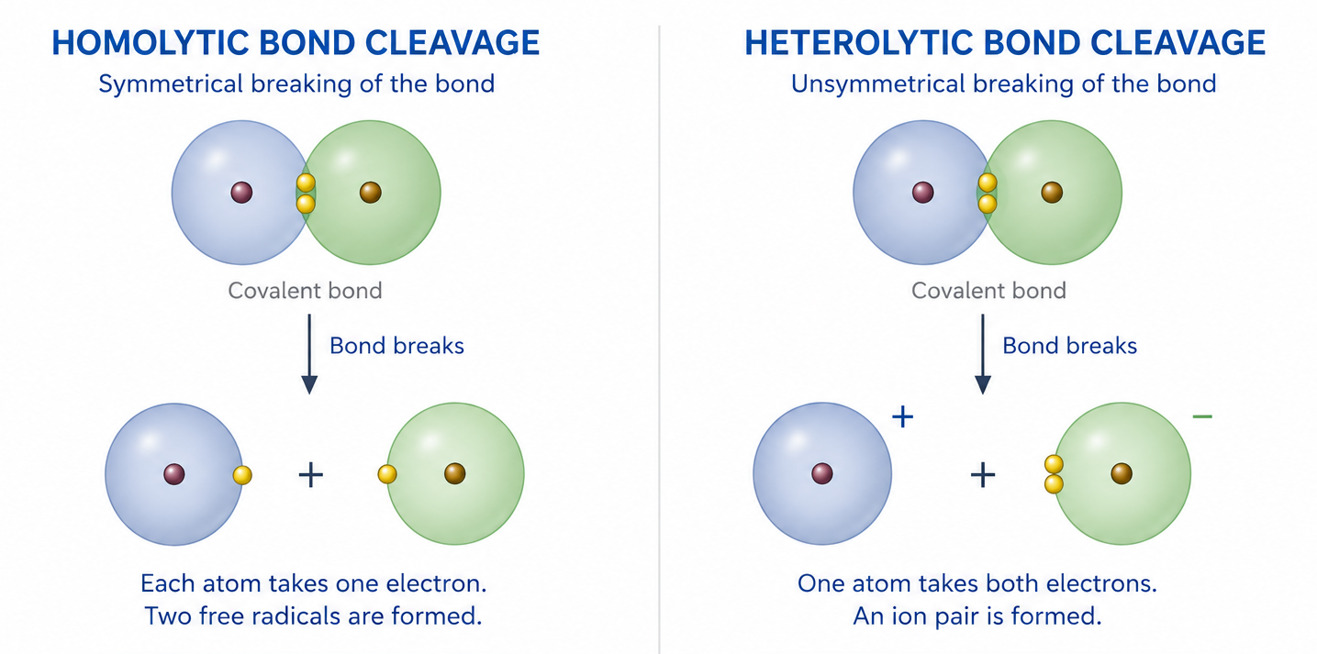
Experiments performed by Baytekin and coworkers [2, 3] have shown that the mosaic of charge is generated by a combination of transfer of material between two touching surfaces and creation of ions due to bond cleavage, and it is also accompanied by the creation of radicals. This insight helps explain several long-standing puzzles. First, it accounts for the highly localized nature of charge generation. Bond-breaking events occur only at specific microscopic contact points, naturally producing the patchwork of charged domains observed by high-resolution imaging. Second, it explains why identical materials can sometimes become oppositely charged. Small variations in surface structure, local stresses, and bond-breaking pathways can lead to different distributions of ions and radicals, even when the two surfaces are chemically similar.
Perhaps most importantly, the mechanochemical model offers an explanation for the remarkable persistence of electrostatic charge in polymers. Once generated, radicals and ions are often trapped within a rigid insulating matrix. Unlike charges in metals, which can move freely and rapidly recombine, charges in polymers may remain confined to specific molecular environments. In fact, the research has revealed an intriguing relationship between radicals and electrostatic charge. Apparently, valence electrons of radicals interact with electron shells of ions, leading to charge stabilization at the polymer surface [4].
Evidence for this connection comes from experiments in which radical-scavenging additives were incorporated into polymers. When substances known to neutralize radicals have been added to plastics, even at a low concentration of 0.1%, the accumulated charge after contact electrification reduced to about 25% and dissipated within minutes, whereas the non-doped material stayed significantly charged even after 24 hours [2]. Such observations suggest that radicals are not merely incidental by-products of bond breaking but active participants in the processes that stabilize separated charge. These findings provide a direct bridge between electrostatics and polymer chemistry and help explain why different materials exhibit dramatically different charging behavior. They also open a completely new avenue for the design of antistatic materials which so far relied on various additives improving the electrical conductivity of a material.
Finally, researchers have also shown that the created charge patterns in their experiment are very similar in standard and water-free atmospheres [2, 5]. This ruled out a significant influence of the redistribution of aquatic ions (H+, OH-) adsorbed to the surface on contact electrification in this experiment, which is one of the polymer contact electrification mechanisms proposed by Whitesides et al. [6].
The emerging picture is therefore far richer than the traditional textbook description of static electricity. Contact electrification is not simply a transfer of electrons or aquatic ions between surfaces. At least in many insulating materials, it involves microscopic mechanical damage, the breaking of chemical bonds, the formation of radicals and ions, and the subsequent trapping and stabilization of these species within the material. Static electricity, long regarded as a purely physical phenomenon, turns out to have a substantial chemical component.
Why does wood behave differently?
At first glance, wood and plastic appear to have much in common from an electrical and chemical perspective. Both are generally classified as electrical insulators and both contain long chains of polymers. Yet anyone who has handled everyday objects is familiar with an important difference: plastic readily accumulates static charge and often retains it for long periods, while wood rarely exhibits comparable electrostatic behavior. Why is this the case?
Traditionally, the weak electrostatic charging of wood has largely been attributed to its moisture content. When water is present, it facilitates the movement of ions and thus the dissipation of electrostatic charge. However, experiments published in [7] show water is not the only contributor to the antistatic properties of wood.
Wood is a composite of three main components - cellulose (30-50%), hemicellulose (20-35%), and lignin (15-40%). Cellulose is a natural polymer that is known to easily acquire an electrostatic charge similar to plastic polymers [8]. Hemicellulose has the same chemistry and thus similar charging behavior as cellulose is expected. Indeed, the experiments described in [7] showed that chemically removing lignin from wood caused it to behave much more like common plastics: after contact, lignin-free wood accumulated large electrostatic charges and retained them for extended periods. When lignin was added back, even a concentration of about 5% was sufficient to restore the antistatic behavior.
To confirm that lignin itself was responsible for the effect, the researchers performed the opposite experiment. They incorporated lignin into the plastic polymer polydimethylsiloxane (PDMS). Adding only 1% lignin noticeably reduced electrostatic charging, while 5% rendered the polymer effectively antistatic.
The authors proposed that lignin acts this way because of its well-known radical-scavenging properties. Lignin contains numerous phenolic groups that readily donate hydrogen atoms to neutralize free radicals generated during mechanochemical bond breaking. According to the radical-stabilization model discussed in the previous section, removing these radicals destabilizes nearby trapped charges, allowing them to recombine more readily and causing the electrostatic charge to dissipate much faster.
The experiments with lignin reveal that wood is not antistatic simply because it is an electrical insulator containing moisture. Rather, its chemical composition actively suppresses long-lived electrostatic charge. Plastics are composed largely of chemically inert polymers that can preserve radicals and trapped charges for long periods. Wood, in contrast, naturally contains lignin—a polymer rich in antioxidant phenolic groups—that continuously scavenges radicals and promotes charge dissipation. From this perspective, wood can be viewed as a naturally occurring antistatic composite, whereas most commodity plastics lack this built-in protection.
These discoveries not only explain familiar everyday observations but also suggest new strategies for designing antistatic materials, from safer plastics for industry to possible approaches to neutralizing the surface charge of nanoplastic particles already circulating in our environment.
About the authors

References
- Baytekin H. T., Patashinski A. Z., Branicki M., et al. “The Mosaic of Surface Charge in Contact Electrification.” Science 333 (2011): 308–312. https://doi.org/10.1126/science.1201512
- Baytekin H. T., Baytekin B., Hermans T. M., et al. “Control of Surface Charges by Radicals as a Principle of Antistatic Polymers Protecting Electronic Circuitry.” Science 341 (2013): 1368–1371. https://doi.org/10.1126/science.1241326
- Baytekin H. T., Baytekin B., Incorvati J. T., et al. “Material Transfer and Polarity Reversal in Contact Charging.” Angewandte Chemie International Edition 51 (2012): 4843–4847. https://doi.org/10.1002/anie.201200057
- Mazur T., Grzybowski B. A. “Theoretical Basis for the Stabilization of Charges by Radicals on Electrified Polymers.” Chemical Science 8 (2017): 2025–2032. https://doi.org/10.1039/C6SC02672A
- Baytekin H. T., Baytekin B., Soh S., et al. “Is Water Necessary for Contact Electrification?” Angewandte Chemie International Edition 50 (2011): 6766–6770. https://doi.org/10.1002/anie.201008051
- McCarty L. S., Whitesides G. M. “Electrostatic Charging Due to Separation of Ions at Interfaces: Contact Electrification of Ionic Electrets.” Angewandte Chemie International Edition 47 (2008): 2188–2207. https://doi.org/10.1002/anie.200701812
- Özel M., Demir F., Karluk A. B., et al. “Why Does Wood Not Get Contact Charged? Lignin as an Antistatic Additive for Common Polymers.” Chemistry of Materials 32 (2020): 7438–7444. https://doi.org/10.1021/acs.chemmater.0c02421
- Zhang R. “The Opportunities of Cellulose for Triboelectric Nanogenerators: A Critical Review.” Nanoenergy Advances 4 (2024): 209–220. https://doi.org/10.3390/nanoenergyadv4030013
© 2026 Jan Kára. This article is published under a Creative Commons Attribution 4.0 International licence (CC BY 4.0) unless a different licence is stated in the credit line of an individual item. The authors retain copyright; ALLATRA Natural Science Review holds the right of first publication. The Review charges no submission, publication, or article processing fees. © 2026 ALLATRA Inc.